
In part two of my budget series, I continue with some definitions and context around the budget; here I’ll provide my perspective on reserves, as well as the tax bill and the Provincial tax cap.
What are Reserves?
Another term you may have heard thrown around during budget talk is reserves. Reserves are “savings” accounts inside the operating budget – in fact HRM has several of them. They’re a little bit more than they sound, but maybe not far off. Reserves are much more than a “rainy day” fund, though they serve that purpose as well. The municipality maintains a few different types of reserves. Some are purpose-built and narrow in focus, some are more broad, flexible and strategic in nature. Three examples:
For District 16 specifically, for example, there is a reserve fund for the Greenfoot Energy Centre – money set aside over time to address forecasted needs as well as small-scale surprises.
At the HRM level, for example, there is a Library Reserve – also money is small increments (though certainly larger than for a single facility) to put money aside specifically for ongoing Library upgrades – new flooring, replacement roofing, heat pump motors, etc.).
Then there is a Strategic Initiatives Reserve (the HalifACT tax itemized on the tax bill goes into this). This is a larger pot funded by a proportionately larger percentage of the tax bill that gets set aside for bigger ticket items that are also planned or forecast. This reserve has contributed to the purchase of big ticket items often associated with sustainability and climate action, like the electrification of the transit fleet, or energy efficiency upgrades to municipal facilities (which then generally decrease operating costs at the same time). This is a valuable planning mechanism intended to avoid a pay-as-you-go model for big ticket purchases.
Imagine the impact of the $100M+ Cogswell District – rather than trying to pay for it all in a short window on the tax bill as it was completed (which would result in a significant increase on the tax bill all at once), we instead “smooth” the impact on the tax bill by collecting a proportion of the committed budget across multiple years leading up to it and a little after completion. And if there are any surprises as a big project continues, the proportion collected can be adjusted rather than a spike at the end. This is a simplified but reasonable way to explain how the reserves save us money in the long term and the value they provide to tax payers and our ability to flexibly respond to big ticket needs, both forecast and potentially unforeseen. Some reserves give the municipality the flexibility to move money around from one account into another when needs shift. Others do not.
In the 2025/26 budget, the very first budget for this council, we agreed to a motion brought by the mayor to take $10M from the Library Reserve to decrease the tax bill – effectively clawing back some of the money the municipality had put aside for the purposes described above. It was a risk, but one tax payers generally supported, in part because lower tax rates are what the mayor promised was his priority during his election campaign and, the message from residents, was that lower taxes were their priority as well. Though residents may not have fully understood the funky accounting this entailed. As a council, we ultimately supported this choice. But we knew it was a one-time artificial lowering of the tax rate. It didn’t actually remove any costs from the municipality, we just removed the purpose-built safety net that served a specific purpose to make it LOOK like we had reduced costs, at least on paper. Was it the right move? Well, just months after the budget was ratified, the Dartmouth North Library suffered a catastrophic flood from a backed up sewer line. Repairs to the library would have been aided with funding not just from insurance but from the Library reserve – the same reserve we had raided to temporarily keep taxes lower for residents. That library is still not yet re-opened a full year later.
So in this budget, council seeks to fix this. We’re topping up the reserve, particularly in light of other major projects in the forecast with funding models that are still being worked on. Big strategic projects on the horizon include a new headquarters for Halifax Regional Police, a significant upgrade to the Burnside Transit Depot, the 4-major projects in one Transit expansion in the form of the Bedford fast ferry project, the Robie Street corridor widening, the Windsor Street Exchange, furthering Halifax Transit’s Core Service Plan, the Halifax Forum and others. It takes discipline and long-term thinking to set aside money proactively to huge projects possible. I hope residents see the wisdom in this approach, even if it means that this year’s tax bill is a little bit higher from this one type of account renewal.
The tax bill, the tax rate, PVSC and the Provincial tax cap
The tax bill includes a series of component lines items that make up your total bill.
The first line on your bill is the municipal general rate portion of your bill. Private residential property owners pay a certain rate per $100 of value as assessed by Property Valuation Services Corporation, a provincial entity. That rate is broken into three categories – urban, suburban and rural – however presently suburban and rural pay the same rate which is lower than the urban rate. The general premise is that urban residences have exposure to more services more of the time and therefore pay a little more. The second line on the bill is the Supplementary Education rate – it’s a municipal contribution to HRCE and CSAP school programs in the municipality. Next is a grouping of Area Rates – there is a Local Transit Rate applied if the residence is within 1000m walking distance of a Halifax Transit bus stop and a Fire Protection Rate which is mandated by the Nova Scotia Regulatory and Appeals Board to fund the hydrant costs incurred by Halifax Water using a formula the Board approved and levied against properties within 1200m of a hydrant. In specific cases, there may be some other form of area rate – like when a neighbourhood agrees to pay a rate over a long period to pay for the addition of a service that was otherwise not built into their neighbourhood originally (this sometimes happens for some sidewalks, water services, etc). Next is the HalifACT climate action tax, a rate applied to fund climate mitigation and adaptation as well as strategic initiatives (as discussed previously). And then finally there is the Provincial rate, which is collected on behalf of the Province of Nova Scotia. Each of these rates are multiplied by the assessed property value, then summed to create the total tax bill, which is then paid in two semi-annual instalments.
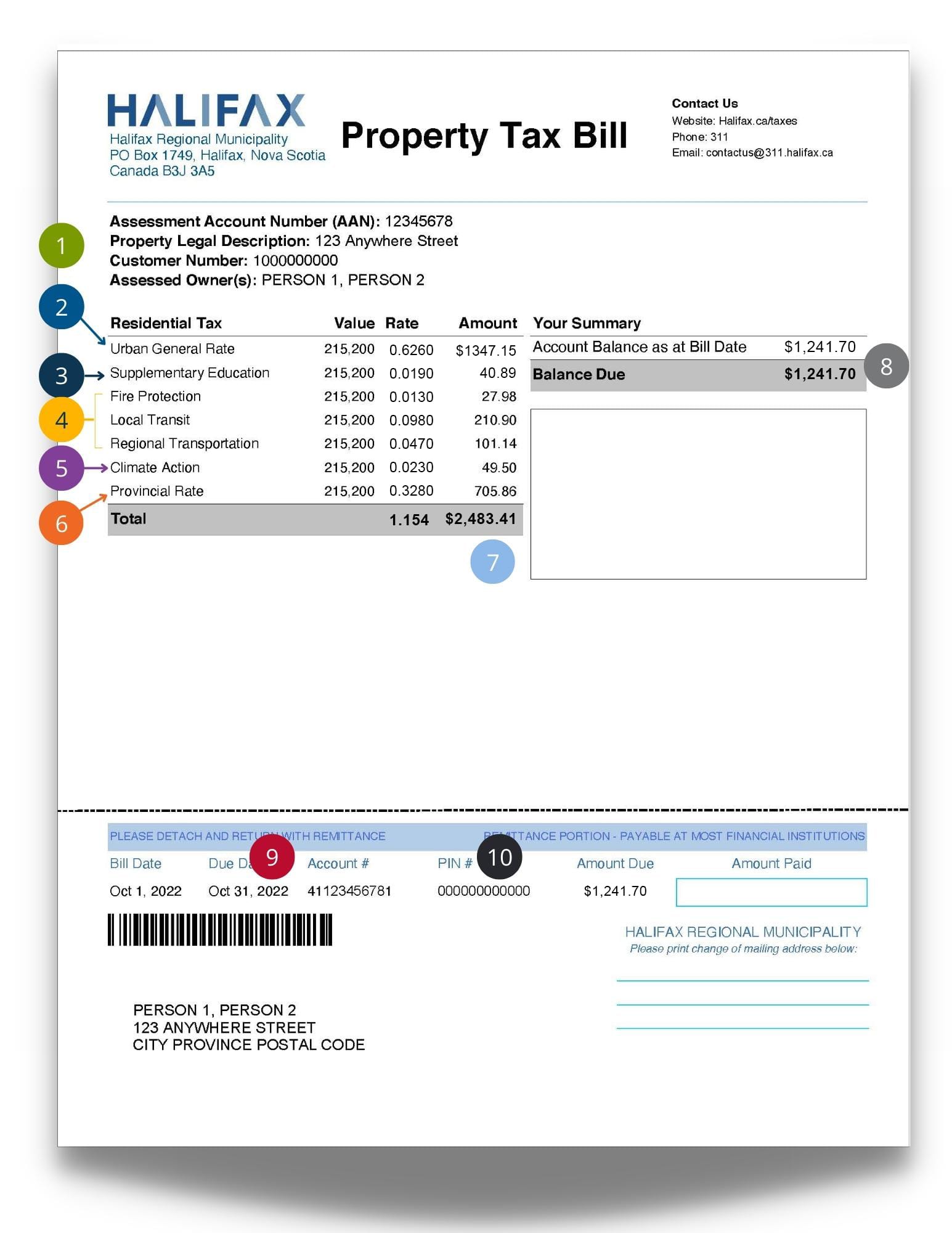
- Property description
- Assessment Account Number
- Property Legal Description
- Customer number
- Assessed Owner(s): Person 1, Person 2
- General tax rate – funds the various services the municipality provides, such as policing, solid waste, recreation programs, libraries and sports fields. The charge on your property tax bill will be listed as urban, suburban or rural, depending on where you live
- Supplementary education rate – used to supplement funding to the Halifax Regional Centre for Education (HRCE) and the Conseil Scolaire Acadien Provincial (CSAP), the province-wide Acadian school board, for programs within the Halifax region
- Area charges – fund specific services in your area and vary depending on where you live. Area charges include:
- Fire protection – the Nova Scotia Utilities and Review Board (NSUARB) requires the municipality to make a contribution to fund the operations of the Halifax Water. This contribution is used to fund the hydrant costs incurred by Halifax Water and is set by a formula approved by the NSUARB. The hydrant charges are recovered via a special fire protection area rate that the municipality levies on all properties within 1,200 feet of a hydrant available for public fire protection. Check the fire protection area map [PDF] to see if this applies to your property.
- Local transit – the boundary for the Local Transit area includes all properties within one kilometre walking distance of any HRM transit stop. This includes conventional transit, park and rides, regional express, ferry terminals, and any other HRM transit stop. Refer to the local transit mapped area to see how your property is affected.
- Climate action – The climate action tax funds projects and programs supporting HalifACT outcomes, including both climate mitigation efforts and adaptation – improving municipal resiliency – with major projects ranging from electrification of buses to retrofitting of existing municipal buildings. With this tax, the approved budget funds the 3-Year Resource Plan outlined in the HalifACT 2020/21 Annual Report provided to Halifax Regional Council December 15, 2021.
- Provincial rate – collected by the municipality on behalf of the Province of Nova Scotia
- Total property taxes for the current year
- Balance due – current amount owing
- Payment due date
- PIN number – required for email/SMS registration
Where does the rate come from? It’s a complicated set of calculations, but in simple terms, the total budget approved by council is the total dollar figure HRM is required by provincial legislation to cover with the combination of tax bill revenue (from residences and businesses) and fees. Because it has a relationship to the valuation of residential and commercial properties, and the total value of properties in HRM is not determined until PVSC completes its valuations for the entire province, the municipality approaches the budget with its best guess initially based on the prior year with small adjustments made to accommodate what the anticipated year over year change might be. PVSC announces the “assessment roll” in January. Before that, the tax rate based on the draft budget is an estimate – and in truth it remains an estimate until staff and council finish the work on the budget. But it’s a starting point at the very least. Because it’s a transparent process, that estimate is released to the public. That can have a negative impact however because the work by staff and Council isn’t yet complete. Residents and businesses quite naturally react to the in-progress budget. But it’s not yet informed by the changes to come.
So when the assessment roll is actually released, the rate and the impact on the average tax bill is slightly more refined, but still not final. If the municipality’s costs stayed exactly the same year over year, there would likely be a lot less to talk about. But since the municipality’s costs are impacted by inflation, contractual increases, union-negotiated increases in salaries and benefits, tariffs, unexpected expenses – and Council taking money out of reserves – the next year looks different than the last. And so that results in ongoing discussions about how much more tax is needed from residents to deliver the same services year over year and/or make reductions or enhancements to services to impact the rate down or up. Further still, some of the types of expenses the municipality had are more exposed to cost pressures than what a typical consumer faces – construction costs, road repair – many of these have gone up much faster that the broad and general rate of inflation across the economy.
One of the things I hear from residents often is that growth should pay for growth. I wish it did. With the math the municipality does on services, that’s really not possible. As I described earlier, the “assets” the municipality uses to deliver service are really liabilities with ongoing and sometimes escalating operational costs. And as we add to this library of “assets” the costs mount with them often at a rate that exceeds the revenue potential from new property and service fee paying residences and businesses in the area. The “assets” often cost many more times than what they take in for revenue. The big ticket core service items of roads, sidewalk and curb maintenance, snow removal, and waste pickup, along with coverage for police, fire, parking compliance, bylaw compliance, planning and development administration, transit – they’re big ticket items and many of them are offered at a loss in the grand scheme of things.
What does the tax cap actually do?
Broadly speaking, with the Province having architected property taxes to occupy the lion’s share of municipal revenue, the tax cap is intended to protect home owners from unpredictability in their assessments having an impact on their property tax bill. The idea is that you pay property tax based on the value of your home when you first buy it. But once you have been in your home for a year, the taxable portion of your home’s assessed value will increase only by a prescribed maximum connected to the rate of inflation regardless of external forces influencing the value of your home. That way if the market value of your home, as assessed by the Property Valuation Services Corporation, goes up dramatically, you’re not suddenly impacted by that spike that was outside of your control. Instead, you are taxed on the taxable portion of the assessment, which goes up, relative to your original assessment at the time of purchase, by only a small percentage.
Historically, the assessed value and the taxable assessed value each rose gradually, with the assessed value outpacing the taxable assessed value comfortably. When the real estate market in Nova Scotia improves, that gap widens. When the real estate market in Nova Scotia gets uncomfortably hot, notably as it did during and coming out of COVID, that gap becomes enormous. If you bought a typical home 10 years ago, you may have bought your home for $300,000. Today, your assessed value might be more like $600,000 (likely more). With the protection of the tax cap, your taxable assessment might be just $380,000, and so it’s based on that value your property tax bill is set. Your neighbour, who bought a house exactly like yours last year for $600,000 has their property tax bill set relative to that figure. Two houses that are almost the same, on the same street, that have the same market value, receiving the same services paying significantly different tax rates. Your neighbour has the misfortunate of having bought their house more recently than you. Or flipped the other way, you’re benefitting tremendously from staying in your home long term, while everyone around you having bought more recently pays much more.
Is that fair? Not particularly. As homeowners and tax payers, we should consider the consequences of that disparity. We all pay for it in different ways:
If after my 10 years I wanted to downsize, I might have a strong disincentive to do so based on two factors: home prices have risen considerably in recent years, so I might see my mortgage increase on a smaller home overall AND I would lose the protection of the tax cap, and therefore potentially pay more tax on my smaller home than I did on my larger home under the cap. A third factor can layer on top of that – what if by the time I was seeking to downsize, I was on a fixed income? While I will still benefit from the tax cap from my second year onward in my downsized home, it’s still jarring to suddenly have to pay more on a smaller home, and that too might weigh on my decision to downsize.
What if I want to upsize my home? Perhaps I’m looking to move on from my first home and go a little larger for my growing family, what impact does the tax cap have on my decision? When I look around the market for a home with more room for a growing family, the value of the homes that meet the need are drastically higher than they used to be. It could be a significant leap to go from the mortgage I have now to the mortgage on a larger home. Couple that with now losing the benefit of the tax cap and therefore paying “full rate” on the new home in the first year (but then protected by the cap from that point forward), I might think twice about leaving my home – a home that might otherwise remain a comparatively affordable starter home for a new family.
What if I’m trying to become a first time homebuyer? Young Canadians, or new arrivals to Canada are feeling the pinch for sure, with the combination of every high valuations and the disproportionate application of the tax cap. When an affordable home already feels beyond reach for many, first time homebuyers, paying the full price of a home and the property tax on the full market value of that home, plus all the other normal expenses a buyer would have – might price them out of the market entirely.
If I choose to rent, or I can’t afford a house, I’m into the rental market. And suddenly due to population growth in HRM and the high degree of competition for apartments or rental homes, those prices have skyrocketed as well. But I just might be able to afford that. Or can I? For a rental property you haven’t gone through the “stress test” required of home buyers to demonstrate the ability to cover the cost of your housing if economic conditions change. So you may be paying a higher percentage of your income for your rental property than a bank would otherwise allow for a property with a mortgage. That then also makes it awfully difficult to save up if you would like to become a homeowner in the future. And what if you are on a fixed-term lease? How much security do you have in the price of your rental property? The tax cap doesn’t shelter multi-unit rental properties with more than 4 units. That applies even more pressure on your rent as the owner passes whatever proportion of that cost they can on to the renter within the confines of the province’s rent cap.
And finally, since owned residential properties have a formula that determines their value and therefore their tax bill, and many of those values are suppressed by the cap, while the municipality is not permitted to operate at a deficit, where does the difference get made up? Commercial rates – and they’re not protected by the cap either. Commercial property owners pay more – they do have their own rate structure, but it is certainly pressured upward by the residential rate being suppressed to the provincial property tax cap.
These scenarios highlight the precariousness that the provincial tax cap brings with it. And when we return to the equity discussion above through this lens, newer home buyers and commercial properties pay considerably more than the rest of the market. And the tax cap suppresses what would otherwise by natural movement in the market with upsizing and downsizing happening unencumbered by these pressures.
What is the overall impact of the tax cap? It’s been studied off and on by government and related organizations since the beginning. The Nova Scotia Federation of Municipalities has done extensive work on it through a province-wide lens. Councillor Janet Steele helpfully brought forward a motion to Council in the fall that requested a staff report to examine the impacts of the tax cap from HRM’s perspective, and I supported it and it passed. You can’t fix what you don’t measure. To be clear, the municipality has absolutely no authority to fix it. It’s Provincial legislation. But we as a Council and most importantly you as residents in HRM deserve a comprehensive and modern analysis of what the tax cap means to you as a tax payer. So a report is all we’re asking for at this time. When it comes back, I expect we will have lots of discussions with residents about what it means and what action residents might like to see taken as a result.
That’s it for this entry in the series. In the next part, I’ll walk you through my perspective of the formal and somewhat exhausting steps we go through to arrive at the HRM budget.